Outlook For Mac 2016 Cannot Log In

Symptoms
In Microsoft Outlook 2016 for Mac, you are repeatedly prompted for authentication while you're connected to your Office 365 account.
Cause
This issue occurs because of the presence of duplicate tokens in the keychain.
Outlook For Mac 2016 Cannot Log Install
Resolution
- Open Outlook 2016 from your Start menu. If you've never used Outlook before, you'll be prompted to create a new account. Click Add Account under Account Information. From the Add Account screen, you can either continue with Auto Account Setup, or select Manual setup or additional server types at the bottom to set up your account manually.
- If a public folder does not have an email address assigned to it, you cannot use Outlook 2016 for Mac to post a message in the folder. To view your subscribed public folders, in the navigation pane, click Subscribed Public Folders.
- You can no longer connect your Mail app to these legacy accounts it seems, but there's a quick solution: go to your Outlook account on the web and create an alias using '@outlook.com.'

To resolve this issue in Outlook 2016 for Mac, install the February 2017 Outlook update (version 15.31.0) from the following Office website:
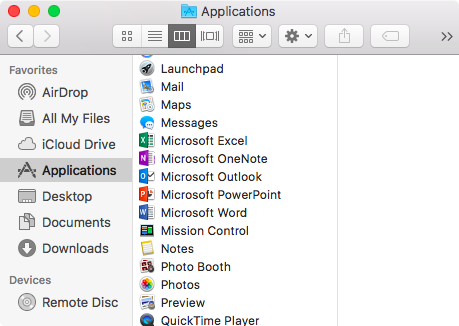
However, Outlook 2016 for Mac looks for a file that is named osfcore.framework and cannot find the file inside the app bundle. To work around this problem, rename the OsfCore.framework file as osfcore.framework. To do this, follow these steps: In Finder, open the Application folder.
Workaround
To work around this issue, delete any cached passwords for your account, and also delete any modern authentication tokens from the keychain. To do this, follow these steps.
Note
These steps affect all Office applications that use modern authentication.
Quit Outlook and all other Office applications.
Start Keychain Access by using one of the following methods:
- Select the Finder application, click Utilities on the Go menu, and then double-click Keychain Access.
- In Spotlight Search, type Keychain Access, and then double-click Keychain Access in the search results.
In the search field in Keychain Access, enter Exchange.
In the search results, select each item to view the Account that's listed at the top, and then press Delete. Repeat this step to delete all items for your Exchange account.
In the search field, enter adal.
Select all items whose type is MicrosoftOffice15_2_Data:ADAL:<GUID>, and then press Delete.
In the search field, enter office.
Select the items that are named Microsoft Office Identities Cache 2 and Microsoft Office Identities Settings 2, and then press Delete.
Quit Keychain Access.
Note
When you start Outlook, you are prompted to authenticate.
Original KB number: 3014451
Symptoms
Microsoft Outlook 2016 for Mac crashes immediately after startup. The crash reporter displays the following error information.
Exception Type: EXC_BREAKPOINT (SIGTRAP)
Exception Codes: 0x0000000000000002, 0x0000000000000000Application Specific Information:
dyld: launch, loading dependent librariesDyld Error Message:
Library not loaded: @rpath/osfcore.framework/Versions/A/osfcore
Referenced from: /Applications/Microsoft Outlook.app/Contents/MacOS/Microsoft Outlook
Reason:image not found
Outlook 2016 Outlook Cannot Logon
Cause
:max_bytes(150000):strip_icc()/08-How-to-access-outlookcom-email-with-outlook-for-mac-511a349ccceb4fb6869a3288881063a4.jpg "2019")
This problem occurs if the underlying file system is formatted as case-sensitive. In this scenario, the file is named OsfCore.framework. However, Outlook 2016 for Mac looks for a file that is named osfcore.framework and cannot find the file inside the app bundle.
Workaround
To work around this problem, rename the OsfCore.framework file as osfcore.framework. To do this, follow these steps:
- In Finder, open the Application folder.
- Right-click Microsoft Outlook, and then select Show Package Contents.
- Open the Frameworks folder, and then find the OsfCore.framework file.
- Select OsfCore.framework, press Return, and then change the file name to osfcore.framework.

More information
Log Into Outlook 2016
You can use Disk Utility to determine whether the file system is formatted as case-sensitive. To do this, run Disk Utility, select the hard disk drive partition, and then select the Erase tab to view the Format option that's selected. If either of the case-sensitive options are selected, you may experience this problem.